
Arkansas court appeals allow a higher court to review a decision issued by a trial court. A party files an appeal after a final judgment if legal error, procedural mistake, or incorrect interpretation of the law affected the case result. Appeals follow strict filing rules set by the state court system. Deadlines are short and begin from the date of judgment. Only specific issues raised during the trial can be reviewed in most cases.
The appellate system in Arkansas reviews records from lower courts and evaluates whether the law was applied correctly. The state court structure, managed by the Arkansas Judiciary, includes the Arkansas Court of Appeals and the Arkansas Supreme Court, which review civil, criminal, and family law rulings. An appeal focuses on legal arguments rather than witness testimony or new evidence. Judges study the trial transcript, filings, and legal briefs submitted by both sides. A case may move to appeal after sentencing, a civil judgment, or a court order. The appellate decision may affirm the ruling, reverse it, modify parts of the judgment, or return the case to the lower court for further proceedings. This structured process keeps court decisions consistent across Arkansas courts and protects the right to fair legal review.
What is the Arkansas Court Appeals System?
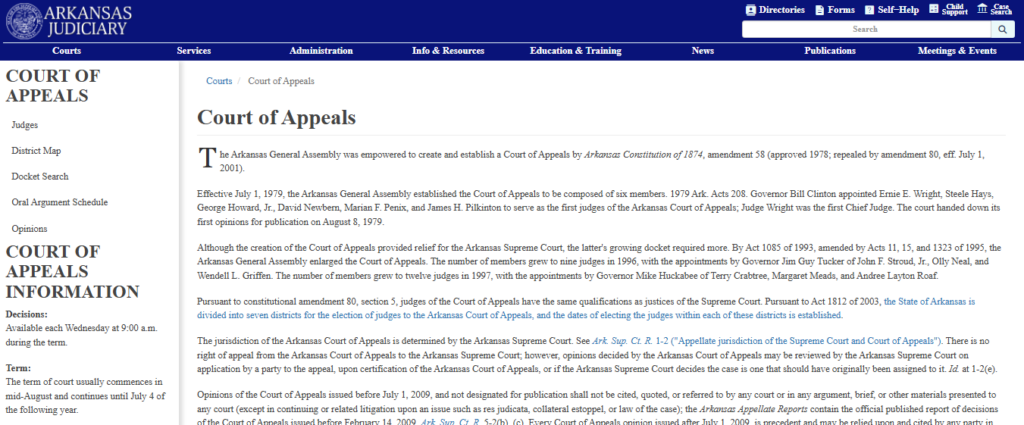
The Arkansas court appeals system reviews trial court rulings to check whether the law was applied correctly. An appellate court in Arkansas studies the record from the lower court and decides if legal https://arcourts.gov/courts/court-of-appeals mistakes affected the outcome. In the state judicial structure, appeals move from trial courts to the Arkansas Court of Appeals, which acts as the intermediate appellate court. Some cases may later move to the Arkansas Supreme Court, the highest court in the state. These courts do not hold new trials. Instead, they review documents, transcripts, and written legal arguments from the original case.
Role of the Arkansas Appellate Courts
The appellate jurisdiction of Arkansas courts allows them to review decisions made by circuit courts and other lower courts. Their main task is to check whether the trial followed the law and proper court procedures. A panel of appellate judges studies the case record and legal briefs submitted by each side.
The judges then issue a written opinion that may:
- Affirm the decision – the trial court ruling stays the same
- Reverse the decision – the lower court ruling changes
- Remand the case – the matter returns to the trial court for further action
These rulings shape how laws are applied across Arkansas.
Review of Lower Court Decisions
Unlike trial courts, the Arkansas court appeals system does not hear new witnesses or review fresh evidence. The court focuses on the trial record, which includes:
- Court transcripts
- Evidence presented during the trial
- Filed motions and orders
- Written legal briefs from both parties
The goal centers on legal error evaluation. Judges examine whether the trial judge misinterpreted the law, allowed improper evidence, or violated constitutional rights.
Types of Cases Heard in Arkansas Court Appeals
The Arkansas appeals court reviews decisions made by lower courts when a party challenges the outcome. Arkansas appellate court cases mainly come from circuit courts and involve legal errors or disputed rulings.
Criminal Appeals in Arkansas Appeal Court Cases
Criminal appeals form a major part of Arkansas appellate court cases and focus on challenges against criminal convictions. These cases often come from circuit courts where trials have already taken place. In the appeal court in Arkansas, the review does not retry the case but checks legal mistakes that may have affected the verdict.
Common examples include:
- Criminal convictions after jury trials
- Sentencing disputes in felony or misdemeanor cases
- Claims of improper evidence use during the trial
For instance, a defendant may argue that court procedures were not followed correctly. The appellate court then reviews trial records to decide if errors impacted the outcome. These criminal appeals often rely on written arguments and prior records instead of new testimony.
Civil and Administrative Appeals in Arkansas Appellate Court Cases
Civil appeals involve disputes between parties over legal rights and financial claims. These Arkansas appellate court cases often include contract disputes and property cases that originate in circuit courts. The Arkansas appeals court reviews whether the law was applied correctly in the original decision.
Common civil and administrative matters include:
- Contract disputes between businesses or individuals
- Property ownership and boundary disagreements
- Administrative appeals involving state agency decisions
Administrative appeals often arise when a person challenges a government agency ruling, such as licensing or regulatory actions. In civil appeals, courts focus on legal interpretation rather than re-evaluating facts. This structure keeps appellate review focused on fairness and legal accuracy across Arkansas court decisions.
When You Can File an Appeal in Arkansas Courts
A party can file an appeal in an Arkansas court action only after the trial court issues a final judgment. Arkansas appeal filing starts when the case reaches a decision that ends the matter in the lower court. An appeal is not allowed during ongoing hearings or partial rulings. The appeal process focuses on reviewing legal errors made in the final decision.
When Appeal Filing Becomes Possible in Arkansas Courts
Arkansas courts allow appeals only after a final judgment is entered. This means the trial court has completed all claims and issued a ruling that closes the case.
The right to file an appeal in the Arkansas court depends on specific eligibility factors:
- A final judgment or final order has been issued
- The case is fully resolved in the trial court
- The appeal is based on a claimed legal error
- The issue is properly preserved in the trial record
Some orders, such as temporary rulings, cannot be appealed immediately. In most civil and criminal matters, appellate eligibility begins only after the case ends at the trial level.
Appeal Deadline and Filing Steps in Arkansas
The appeal deadline in Arkansas is strict. A notice of appeal usually must be filed within 30 days of judgment entry. Missing this deadline can stop the appeal process completely.
Filing steps include:
- Filing a notice of appeal with the trial court
- Identifying the judgment being challenged
- Preparing the record for appellate review
- Following court filing requirements under Arkansas rules
| Item | Requirement |
|---|---|
| Filing trigger | Final judgment |
| Deadline | About 30 days |
| Basis | Legal error in ruling |
| Filing document | Notice of appeal |
Arkansas appeal filing focuses on correcting legal mistakes, not re-trying the case facts.
Steps in the Arkansas Court Appeals Filing Process
A court appeal filing in Arkansas follows a structured legal sequence that starts after a final judgment is entered. The Arkansas court appeal process requires strict timing, proper documentation, and submission of records to the appellate court. Each stage focuses on specific documents such as the notice of appeal, court record, and appellate brief. Missing any step can delay or affect the appeal review.
A party begins an appeal filing after a trial court decision is issued. The process moves from filing notice to preparing the full court record and submitting written arguments. Arkansas appellate courts review the case based on records, not new evidence. The process focuses on legal errors, procedure review, and written arguments presented through briefs.
File Notice of Appeal
The appeal filing process starts with the notice of appeal. This document informs the trial court and opposing party about the intent to challenge the judgment. The notice must be filed within a strict deadline after the final order. Missing this filing window can end the right to appeal. The clerk filing office records the document and starts the appellate timeline.
Points include:
- Filing with the trial court clerk
- Sending notice to all parties
- Meeting the required deadline under Arkansas rules
Prepare Record on Appeal
The next step involves building the court record for review. This record contains all materials used in the trial court.
The record on appeal may include:
- Transcripts of hearings
- Exhibits submitted during the trial
- Court orders and motions
- Docket entries from clerk filing systems
The trial court clerk works with the appellant to assemble and certify the record. This step shapes what the appellate judges review.
Submit Appellate Brief
The appellant prepares an appellate brief that explains legal errors in the case. This document presents arguments supported by law and record references.
The brief often includes:
- Statement of facts from the trial record
- Legal issues raised on appeal
- Arguments based on Arkansas law
- Requested outcome from the appellate court
Strong writing and clear citations from the record can influence the review process.
Response Brief from Appellee
The opposing party, called the appellee, submits a response brief. This document defends the trial court’s decision.
The appellee may:
- Challenge the appellant’s claims
- Support trial court findings
- Use case law to support the ruling
The response brief focuses on upholding the original judgment through legal reasoning and record support.
Reply Brief
The appellant may file a final reply brief after reviewing the response. This step addresses points raised by the appellee.
The reply brief:
- Clarifies disputed arguments
- Refocuses on key legal errors
- Uses references from the existing court record
After this stage, the appellate court reviews all filings and may schedule oral arguments before issuing a decision on the Arkansas court appeal process.
Preparing the Record on Appeal
The court record appeal contains all documents and materials used in the trial court. The appellate record gives the higher court a complete view of what happened in the case. It includes filings, transcripts, and evidence submitted during trial. This record works as the official case history for appellate review. Without a complete record, the appellate court cannot review legal errors or decisions made in the lower court.
What the court record appeal includes
The court record appeal contains several key documents that reflect the full trial process. Each item helps the appellate court review facts and rulings.
Common items include:
- Trial transcripts from hearings and testimony
- Court filings such as motions, petitions, and responses
- Exhibits like photos, contracts, or physical evidence
- Orders and judgments issued by the trial court
- Jury instructions and verdict forms
These materials form the official appellate record. Each document must match what was submitted during the trial phase. Missing or incorrect items can delay the appeal process.
Building the appellate record for review
The appellate record is prepared by the trial court clerk with input from both parties. Attorneys often request specific materials to be included.
| Record Component | Purpose in Appeal Review |
|---|---|
| Trial transcripts | Show spoken testimony and rulings |
| Court filings | Present motions and legal arguments |
| Exhibits | Support factual claims with evidence |
| Court orders | Document final and interim decisions |
The record is then sent to the appellate court for review. Judges rely on it to evaluate whether legal errors affected the outcome of the case.
Appellate Brief Requirements in Arkansas
Appellate briefs in Arkansas set out the written case for review before an appellate court. They explain what part of the lower court decision is being challenged and why the ruling should change. These briefs follow strict formatting, structure, and citation rules under Arkansas appellate procedure. A strong filing presents clear appeal arguments, supported by law, record facts, and prior rulings.
Statement of Facts
The statement of facts section presents the case history in a neutral format. It avoids opinions and focuses on record-based events from trial court filings.
This section often includes:
- Timeline of key events from the trial court record
- Relevant motions, hearings, and rulings
- Facts supported by transcript references
- Clear presentation of disputed and undisputed points
Courts rely on this section to understand the background before reviewing legal issues. Any distortion of facts can weaken the appellate brief Arkansas filing.
Legal Arguments
The legal arguments section forms the core of the appellate brief. It explains why the lower court decision contains an error based on law or procedure.
This section typically includes:
- Appeal arguments tied to specific trial court rulings
- References to statutes and procedural rules
- Case precedent from Arkansas or higher courts
- Structured legal argument points supported by reasoning
Citation rules play a major role here. Every claim must connect to the record or a valid authority. Courts expect precise citations to transcripts, exhibits, and prior decisions.
Oral Arguments in the Arkansas Court of Appeals
Oral argument appeal in the Arkansas Court of Appeals gives attorneys a short time to speak directly to appellate judges. It is not required in every case and may be skipped. Many appeals are decided from written briefs alone.
Purpose of Oral Argument Appeal in the Court of Appeals
An oral argument appeal serves as a direct discussion between attorneys and appellate judges. It gives a chance to clarify points written in briefs and answer questions from the bench. Appellate judges review the written record before the hearing. The oral session works as a short legal presentation focused on disputed issues. It is not a trial, and no new evidence is presented.
Purposes include:
- Clarifying legal arguments already in briefs
- Responding to questions from appellate judges
- Highlighting key legal errors from the lower court
- Addressing specific statutes or case law references
The court often sets strict time limits. Attorneys must present clear and direct points within a short window. The focus stays on legal reasoning rather than emotional appeal.
How Appellate Judges Use Oral Argument Time
Appellate judges use oral argument appeal sessions to test legal reasoning and identify weak or strong points in each side’s position. Questions often target unclear parts of the written briefs. Many cases are fully decided without oral argument. Judges may rely only on written submissions when the facts and law are clear.
During an oral presentation, judges may:
- Ask direct questions about legal interpretation
- Compare arguments from both sides
- Test consistency with prior court rulings
- Clarify disputed facts already in the record
In some appeals, oral argument lasts only a few minutes per side. In others, judges may extend questioning when legal issues appear complex. Written briefs still carry the main weight in most appellate decisions, with oral argument serving a supporting role in the review process.
Possible Outcomes of an Arkansas Appeal
An Arkansas appeal can end in several different ways after the appellate court reviews the lower court record. Each outcome appears in a written court opinion that explains the appellate decision and its legal reasoning. The result of an appeal depends on how the appellate judges view errors, facts, and law application in the original case. These outcomes directly affect the final status of the judgment.
Appellate decision outcomes
The Arkansas appellate court may issue one of the following results:
- Affirm: The court upholds the original judgment. The lower court ruling stays in place with no change.
- Reverse: The court rejects the lower court decision. The result changes in favor of the appealing party.
- Remand: The case goes back to the lower court for another hearing or new trial steps.
- Modify judgment: The court adjusts part of the original ruling without sending it back.
Next, these outcomes are explained in a simple comparison format for clarity.
| Outcome | Meaning | Effect on Case |
|---|---|---|
| Affirm | Original ruling stands | No change in judgment |
| Reverse | Decision overturned | Sent back to the trial court |
| Remand | Sent back to trial court | Further proceedings required |
| Modify judgment | Partial change in ruling | Adjusted final order |
Each appellate decision shapes how the case moves forward in Arkansas courts. The written court opinion also becomes part of the legal record for future reference.
Appeal Filing Fees and Costs
Appeal filing fees in Arkansas typically range from about $165 to $185 for civil appeals, depending on record preparation and court requirements. Extra court costs and clerk filing fees may apply based on the case type and transcript needs. Appeal filing fees in Arkansas vary across circuit courts. Most civil appeal cases include a base filing charge set by the clerk of the court. Court costs may increase when transcripts or certified records are required for the appellate record sent to a higher court.
Factors affecting total cost include:
- Record format (paper or electronic)
- Transcript preparation charges
- Clerk filing fees per document
- Certification and copy charges
| Fee Type | Estimated Cost |
|---|---|
| Base appeal filing | $165–$185 |
| Transcript fee | Varies per page |
| Clerk copy fees | Small per page charge |
| Certification fee | Small per-page charge |
(FAQs) About the Arkansas Court Appeals Process Filing
This section explains common questions about the Arkansas Court Appeals Process, filing in a clear and simple way. It focuses on timelines, evidence rules, filing steps, and outcomes after appeal decisions. Each answer helps clarify how the appellate process works in Arkansas courts.
How long do Arkansas appeals take?
Arkansas appeals usually take several months and sometimes more than a year. The time depends on case type, record preparation, and court schedule. Criminal cases may move faster than civil matters in some situations. After filing, the record is prepared and sent to the appellate court. Then, the briefs are reviewed before any ruling is issued.
Can new evidence be submitted in the appeal?
New evidence is not allowed in most Arkansas appeals. The appellate court reviews only the trial record, including transcripts and filed documents. The focus stays on legal errors made during the original case. No new facts are added at this stage. In rare cases, issues may be sent back to the trial court for review.
What is a notice of appeal?
A notice of appeal is a formal filing that starts the appeal process. It informs the court and the other party that the decision will be reviewed. It must be filed within strict deadlines after the final judgment. Missing the deadline can stop the appeal process. It includes basic case details and the challenged judgment.
Can appeals go to the Supreme Court?
Some Arkansas appeals go directly to the Arkansas Supreme Court. Others first go to the Arkansas Court of Appeals. The Supreme Court handles cases involving major legal or constitutional issues. The Court of Appeals handles most routine appeals. A party may request higher review after a lower appellate decision.
What happens after an appellate decision?
After an appellate decision, the case outcome may change or remain the same. The court may affirm, reverse, or send the case back to trial court. An affirmed ruling keeps the original judgment in place. A reversal changes the outcome based on legal findings. A remand sends the case back for further court action.